Showing posts with label Codroy Valley. Show all posts

Monday, 6 February 2017

December and January SAM Community Updates

New-Wes-Valley signed a Habitat Stewardship Agreement on January 20, 2017.
The SAM community grew again this month when New-Wes-Valley signed a municipal habitat stewardship agreement and became our 37th member. The agreement designates two areas as protected Management Units: Business Pond (1,091 acres) and Queen's Meade (Newtown) (44 acres) for a total of 1,135 acres. Business Pond is an important community hub: the site of a recent art project from Bonavista North Museum & Gallery entitled REDress, and a popular boardwalk trail. Queen's Meade is becoming a birding hotspot, with 38 species sighted in 2015-2016, including the federally endangered Red Knot. The conservation of both of these areas demonstrates the Town's commitment to stewardship and the protection of habitat for wildlife and people. For more information about the Town of New-Wes-Valley and their stewardship agreement, visit their community profile on our website.


SAM Network News & Updates

  • World Wetlands Day was February 2! This day marks the adoption of the Ramsar Convention on Wetlands in 1971, and is a celebration of the importance of wetlands around the world. The theme this year was Wetlands for Disaster Risk Reduction. We hope you took the opportunity to visit your local wetland, clean-up litter, or read up on these unique habitats. Ducks Unlimited Canada and SAM staff marked the day at Manuels River Interpretation Centre in Conception Bay South, with an afternoon of family activities.
  • Applications for Nature NL's Wild Things Scholarship are due on March 20. This $1000 award celebrates residents of NL that are, or will be, enrolled in a post-secondary program, and who have shown an active commitment to the environment through their volunteer activities. Applications are also open for the SAM Conservation Scholarship; apply by May 1.

SAM Conservation Scholarship: Torbay
The second annual SAM Conservation Scholarship was presented to Mr. Willem Peters in Torbay in early December. Mayor Ralph Tapper and SAM President Linda Bailet presented the award to Mr. Peters. Willem is completing a Masters degree in Resource and Environmental Management at Simon Fraser University in Vancouver, BC. Applications for the 2017 SAM Conservation Scholarship are due on May 1.

Celebrating 30 years: Codroy Valley
Conservation efforts in the Codroy Valley reach a big milestone this year. On May 27, 1987, the Grand Codroy Estuary became the first (and remains the only) wetland in NL to be classified as a Wetland of International Significance under the Ramsar Convention. Thirteen years before, in 1974, local residents came together to request a closure to hunting in the Estuary. The local community continues to be a driving force behind conservation and stewardship in the Valley.

Green Team 2016: Come By Chance
The Town of Come By Chance had a busy season with their Green Team in the summer of 2016. The Team was able to complete several beautification projects around the Come By Chance Estuary, including trail maintenance, litter removal and installing interpretive signage. After a successful season, the Town plans to re-apply for another Team in 2017. Applications for Green Teams are due February 24apply here.


Wednesday, 4 January 2017

Species at Risk in SAM Communities

Endangered species in Canada are protected under the Species at Risk Act. The goal of this legislation is to protect species and their habitats that are endangered, or at risk of becoming endangered. Several municipalities in Newfoundland and Labrador have taken steps to protect land within their municipal boundaries that is habitat for a listed species. Conservation plans in these communities highlight existing work or suggest future opportunities for stewardship and protection of these species.

Definitions

Endangered: A wildlife species facing imminent local or global extinction.
Threatened: A wildlife species that is likely to become endangered if nothing is done to reverse the factors leading to its local or global extinction.
Vulnerable: A wildlife species that has characteristics which make it particularly sensitive to human activities or natural events.


Photo: NL Wildlife Division staff.
Piping Plover (Endangered)

The Piping Plover (Charadrius meolodus) is a small, sand-colored shorebird, with a black breast band, black band above its forehead, and a partially black tail. It has a white rump with an orange beak with a black tip. The Piping Plover winters along the Atlantic coast and the Caribbean but there is a breeding population in Newfoundland. Because they nest on the ground, they are very vulnerable to disturbance. Eggs can be destroyed by off-road vehicles, dogs, and pedestrians. Additionally, predation rates of mink and other animals have increased in recent years.
Every summer, the population of Piping Plovers in Newfoundland hovers around 36. They nest on the beaches in four SAM member communities: Burgeo, Port aux Basques, Grand Codroy Estuary, and Stephenville Crossing. Conservation plans in these communities incorporate stewardship initiatives to protect and increase the Plover population.
                 
Photo: NL Wildlife Division staff.
Harlequin Duck (Vulnerable)

The Harlequin Duck (Histrionicus histrionicus) is a small sea duck. Males have a complex plumage pattern with the head and neck being dark slate blue, a large white crescent in front of the eye, a small round dot behind the eye, and a larger oval spot down the neck. A black crown stripe runs atop the head, with chestnut patches on either side. The body is mostly a lighter slate blue with chestnut colored sides. Females are far less colorful, with a brownish-grey body and patches of white behind, below, and in front of the eye. The Eastern Harlequin Duck is threatened by timber harvest and hydroelectric development in breeding habitats. In wintering locations, fishing nets, aquaculture development, disturbance, and oil spills are potential threats.
The population winters along the eastern seaboard and breed in Quebec and Newfoundland and Labrador. SAM member communities such as Mary’s Harbour, Red Bay, St. Lawrence, and St. Lewis are areas where Harlequin Ducks are often spotted. While population levels seem to be increasing in wintering locations, the eastern population has still not reached a sustainable level.

The Limestone Barrens

The Limestone Barrens is an area along the western coast of the Northern Peninsula of Newfoundland, extending from Port au Choix to Burnt Cape Ecological Reserve. This area is extremely unique as it supports a very high percentage of rare plants. Of the 298 vascular plants considered rare in Newfoundland, 104 occur within the Barrens and 22 of these species are endemic to the area! The Limestone Barrens are of special significance and require management and protection. Port au Choix and Flower's Cove signed stewardship agreements to conserve this unique habitat and the rare species within. Many of the rare species found in these communities are at risk, such as Fernald’s Braya and Woolly Arnica.

Photo: Parks Canada.
http://www.pc.gc.ca/
Fernald’s Braya (Threatened)

Fernald’s Braya (Braya fernaldii) is a plant that grows only on the Northern Peninsula of Newfoundland. It is remarkably well adapted to limestone soils and extreme winter cold. It has a deep taproot, fleshy leaves, and erect, flowering stalks up to 7 cm high. The fruit is an elongate, usually hairy capsule and the flowers are white/pink in color. Populations have been disturbed by human activity such as quarrying and road development. In addition, populations are limited by off-road vehicle activity, insects such as the diamondback moth, and various diseases.

Photo: A Digital Flora of Newfoundland and Labrador
http://digitalnaturalhistory.com/
Woolly Arnica (Endangered)

Woolly Arnica (Arnica angustifolia subsp. Tomentosa) is a member of the sunflower family and produces one single yellow flower per stem. It has long narrow leaves and the whole plant is covered with woolly hairs. They have become endangered as they have a limited ability to multiply or colonize new areas and have lost habitat due to climate change and disturbance such as off-road vehicle activity and quarry development.


Friday, 9 December 2016

October and November SAM Community Updates

Indian Bay Brook Management Unit is in our newest SAM member community, Indian Bay.

Indian Bay Becomes Newest SAM Member

It's official: we have a new member community! The Town of Indian Bay is the most recent municipality to sign a wetland stewardship agreement with the provincial government, and to publicly commit to conserving habitat for wildlife and people. After a collaborative process between the Town, the NL Wildlife Division, the Indian Bay Ecosystem Corporation (IBEC) and SAM, a 2,857 acre area was set aside as the Indian Bay Brook Management Unit. This area has a rich and diverse ecosystem and includes habitat for several species, including Brook trout and the vulnerable Banded killifish, and several species of birds and mammals. IBEC is a local non-profit community organization that provided invaluable insight and support in the establishment of this agreement, and continues to enhance communities in the Indian Bay watershed by delivering restoration projects and stewardship opportunities.
For more information about this stewardship agreement, visit the Indian Bay member profile on our website.


SAM Network News & Updates

  • The SAM staff have moved to St. John's. We will be in a new office in the new year, and will update our contact information at that time. In the meantime, you can always reach us by email: samstewardship@gmail.com (Outreach and Stewardship Coordinator, Emma Bocking) or samconservation@gmail.com (Conservation Biologist, Laura King).
  • Our website is always being updated with new resources and information. Some new updates include: Staff biographies, recent funding opportunities and information about all 37 of our member municipalities.
  • If you are driving down the TCH towards Port aux Basques, keep an eye out for our new road sign near the turn off to Doyles, announcing the importance of the nearby Grand Codroy Estuary.

Wetland Restoration: Bonavista
SAM has received funding from the National Wetland Conservation Fund for the restoration of O'Dea's Pond in Bonavista. Over the years, the pond has filled with grassy vegetation, which is impeding flow through of water. The Bonavista Environment Committee started work on this project in late September. The first step: dredge out selected areas of vegetation to increase flow (pictured here, in October). Eventually, the Committee hopes to create nesting islands for waterfowl that would be safe from the local population of domestic cats. In the spring, students from Matthew Elementary School will be involved with planting native species of willow, site clean-ups and educational activities relating to this restoration project. Check out this news story for more information.


Ongoing Restoration Project: Shearstown Estuary

Work continues on an ongoing project to improve water quality and flow through the Shearstown Estuary by installing several culverts through a pre-existing railway berm. On November 18, the ribbon was cut on new interpretive signage for the project, which highlights the importance of the culverts for allowing free passage of fish, including Atlantic salmon. SAM staff continue to monitor water quality variables throughout the Estuary


Project Webfoot: St. Anthony
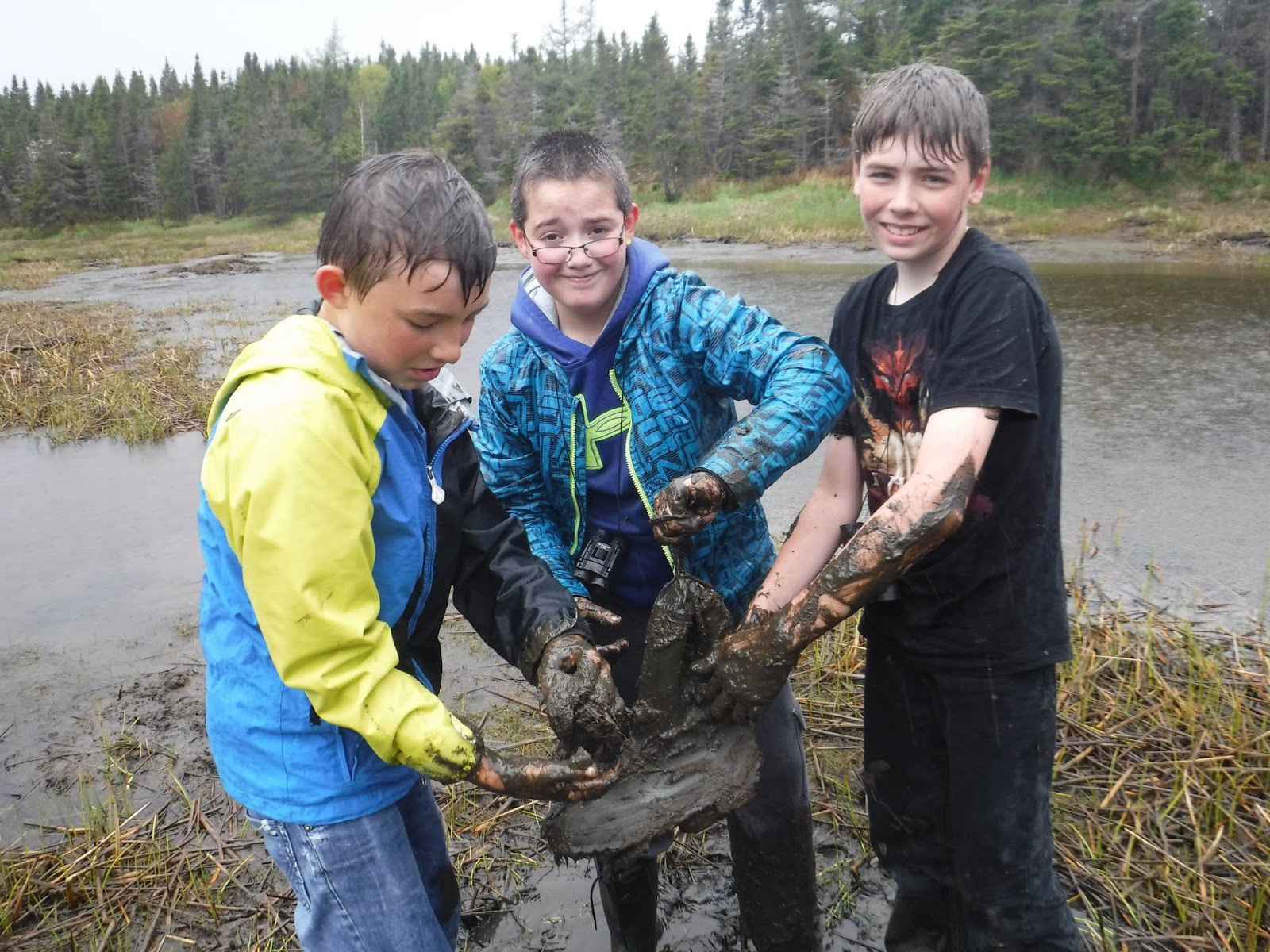
Ducks Unlimited Canada NL staff visited St. Anthony in mid-October to deliver a Project Webfoot field trip. The grade 4 students from White Hills Academy critter dipped for tiny macro-invertebrates, learned about wetland values, and practiced calls and songs from common wetland birds.

Thursday, 4 August 2016

June and July SAM Community Updates

Summer is a busy season for stewardship and conservation. Here are three activities that kept us out of the office this summer.


Interpretive Hike: Burgeo
On the last weekend of July, Burgeo invited SAM to participate in its Sand and Sea Festival. SAM staff led an interpretive hike through the trails and beaches of Sandbanks Provincial Park. The hike was greatly enhanced by the wealth of local knowledge provided by Burgeo residents. Burgeo has been a member of SAM since 2010, and is looking forward to being more involved in the SAM community moving forward!


Wetland Mapping Fieldwork
SAM is involved in a pilot project to produce an inventory and a map of wetlands in Newfoundland and Labrador. The project is led by C-Core (a non-profit research based organization based at MUN), and the fieldwork element is a collaborative effort between C-Core and the NL EHJV partnership. During July and August, these partners are collecting data on wetland classification in multiple pilot areas, including around Happy Valley - Goose BayDeer Lake and the NE Avalon Peninsula, near PC-SPTorbayFlatrockSt. John's and Bauline.


Nest Box Workshop:Codroy Valley
On May 30, staff from DUC and NCC partnered up to deliver a nest box workshop for students at Belanger Memorial School in Upper Ferry, in grades K-6. Three boxes were installed, which will provide nesting habitat for ducks that nest in tree cavities, such as mergansers and goldeneyes. The students at the school agreed to be stewards of these three new nest boxes, and to inspect them every year for nesting activity.

Thursday, 30 June 2016

SAM Annual General Meeting in the Codroy Valley


SAM held its Annual General Meeting this year in the Codroy Valley on June 17-18. We would like to thank our hosts, the residents of the Codroy Valley for being so welcoming, and Kathleen Blanchard and her staff at Intervale Associates for arranging the logistics of the weekend.

On Friday evening, participants were treated to a delicious buffet supper and had the opportunity to meet several local residents. SAM President Linda Bailet was the MC for the night, and introduced Claudelle Devoe, Chair of the Codroy Valley Area Development Association and Local MHA Scott Reid, who both gave welcoming remarks. Local resident Derek White gave a very informative presentation on the natural, social and geological history of the region, and the event was topped off by some lively traditional music from local musicians.


View of the Grand Codroy Estuary.
At the business meeting on Saturday, delegates from 18 member municipalities reported on their town's latest stewardship and conservation initiatives. It has been another busy year for our members, with many clean-ups, trail developments, community gardens, interpretive centers and more on the go. A major topic of discussion during the meeting was the development of a provincial wetland policy, and the historic and future role of SAM in fulfilling this goal. SAM supports the development of a wetland policy, because it is an important step in safeguarding significant wetland habitat, and could provide a framework for future restoration opportunities.

SAM Members search for the Great Blue Heron.
After the meeting SAM members were treated to a tour of the Grand Codroy Estuary, which is Newfoundland and Labrador's only Ramsar Wetland of International Significance. Participants were able to view the provincially rare Great Blue Heron and the endangered Piping Plover - and even four plover chicks! The field trip was followed by dinner and more live music at the Silver Sands Restaurant and Lounge. Thank you again to our hosts for all of their hard work, and thank you to the delegates who attended!
SAM Members view the endangered Piping Plover on the beach.

Save the date for the next SAM meeting: it will be held in Happy Valley - Goose Bay on September 23-24, 2016. See you there!

Wednesday, 27 April 2016

Upcoming Stewardship Workshop: Working Together for Birds, Wetlands, and Community in the Codroy Valley

There is a long history of conservation and stewardship in the Codroy Valley. This stewardship workshop will draw on ideas brought forth at two previous workshops, and will continue to plan future actions in the area. Details of the event are included in the poster below.