| |||||||||||||||||||||
|
Showing posts with label nest boxes. Show all posts
Showing posts with label nest boxes. Show all posts
Tuesday, 2 May 2017
February and March SAM Community Updates


Thursday, 4 August 2016
June and July SAM Community Updates
Summer is a busy season for stewardship and conservation. Here are three activities that kept us out of the office this summer.

 Interpretive Hike: Burgeo
On the last weekend of July, Burgeo invited SAM to participate in its Sand and Sea Festival. SAM staff led an interpretive hike through the trails and beaches of Sandbanks Provincial Park. The hike was greatly enhanced by the wealth of local knowledge provided by Burgeo residents. Burgeo has been a member of SAM since 2010, and is looking forward to being more involved in the SAM community moving forward!
 Wetland Mapping Fieldwork
SAM is involved in a pilot project to produce an inventory and a map of wetlands in Newfoundland and Labrador. The project is led by C-Core (a non-profit research based organization based at MUN), and the fieldwork element is a collaborative effort between C-Core and the NL EHJV partnership. During July and August, these partners are collecting data on wetland classification in multiple pilot areas, including around Happy Valley - Goose Bay, Deer Lake and the NE Avalon Peninsula, near PC-SP, Torbay, Flatrock, St. John's and Bauline.

 Nest Box Workshop:Codroy Valley
On May 30, staff from DUC and NCC partnered up to deliver a nest box workshop for students at Belanger Memorial School in Upper Ferry, in grades K-6. Three boxes were installed, which will provide nesting habitat for ducks that nest in tree cavities, such as mergansers and goldeneyes. The students at the school agreed to be stewards of these three new nest boxes, and to inspect them every year for nesting activity.


On the last weekend of July, Burgeo invited SAM to participate in its Sand and Sea Festival. SAM staff led an interpretive hike through the trails and beaches of Sandbanks Provincial Park. The hike was greatly enhanced by the wealth of local knowledge provided by Burgeo residents. Burgeo has been a member of SAM since 2010, and is looking forward to being more involved in the SAM community moving forward!

SAM is involved in a pilot project to produce an inventory and a map of wetlands in Newfoundland and Labrador. The project is led by C-Core (a non-profit research based organization based at MUN), and the fieldwork element is a collaborative effort between C-Core and the NL EHJV partnership. During July and August, these partners are collecting data on wetland classification in multiple pilot areas, including around Happy Valley - Goose Bay, Deer Lake and the NE Avalon Peninsula, near PC-SP, Torbay, Flatrock, St. John's and Bauline.

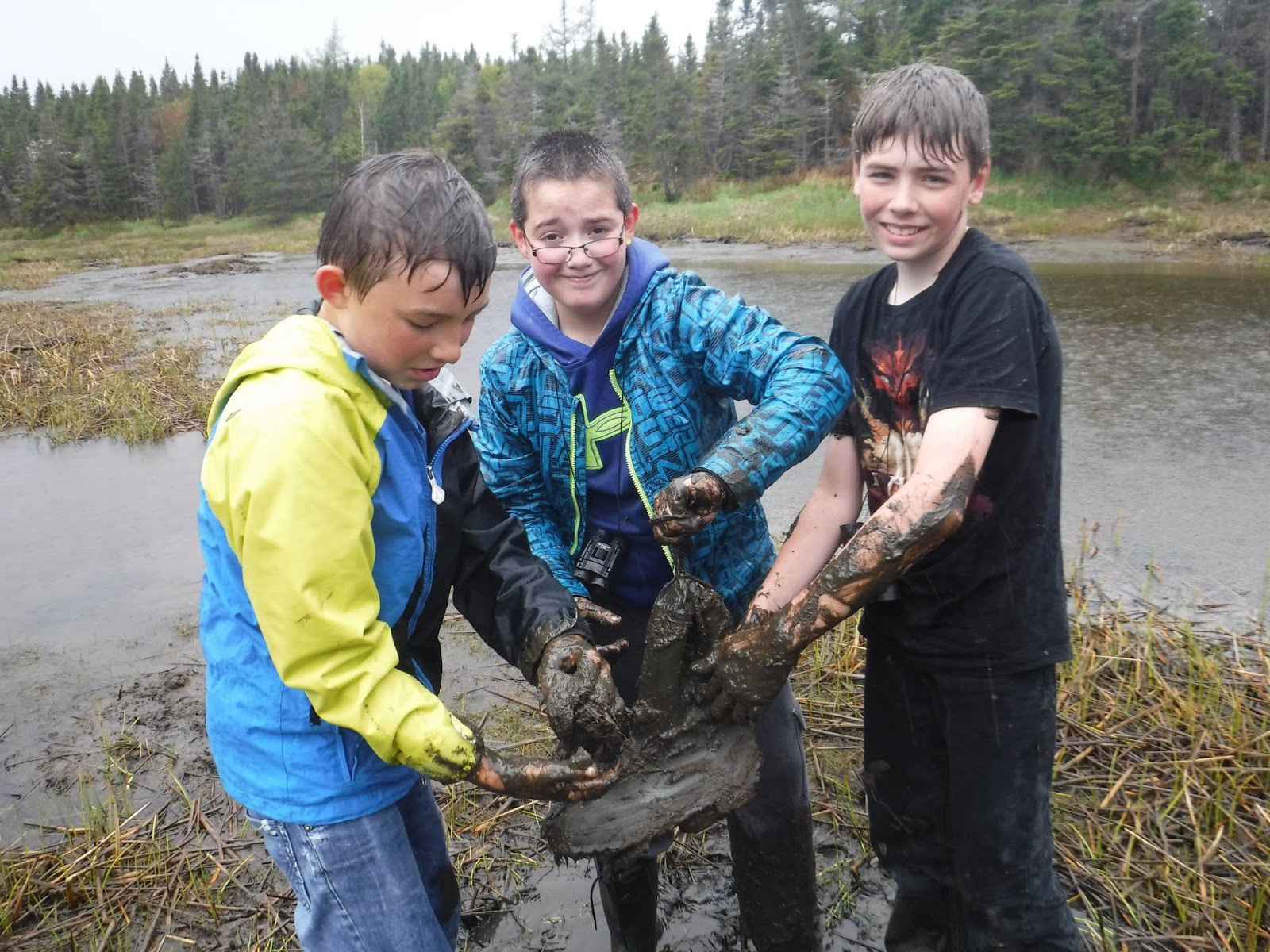
On May 30, staff from DUC and NCC partnered up to deliver a nest box workshop for students at Belanger Memorial School in Upper Ferry, in grades K-6. Three boxes were installed, which will provide nesting habitat for ducks that nest in tree cavities, such as mergansers and goldeneyes. The students at the school agreed to be stewards of these three new nest boxes, and to inspect them every year for nesting activity.
Friday, 30 October 2015
All About Eiders: Eider shelter installation near Musgrave Harbour
 |
| A volunteer carries an eider shelter on South Penguin Island |
 |
SAM President Linda Bailet checks old eider shelters for signs of nesting.
On a calm afternoon in late September, Carmanville Councillor and new SAM President Linda Bailet accompanied local fishermen and residents of Musgrave Harbour and surrounding area on a mission to install 20 new eider shelters. Nest shelters, which were built locally with funding provided by Ducks Unlimited Canada NL, have been installed by volunteers and DUC NL staff for several years, and both North and South Penguin Island are now host to dozens of nest boxes. Common eiders nest on the ground under low, shrubby trees called tuckamore or in thick grass near the shore. Constructed shelters protect nesting eiders from predation when this natural shelter is not available.
|
 |
| Eider shelters old and new, South Penguin Island |
 |
| A peek inside an old eider shelter reveals eider egg shell fragments. |
Organizations like Ducks Unlimited Canada and the Sea Duck Joint Venture support research programs to study these birds, but there is still a lot to learn about their migration routes, characteristics of the best breeding spots and how population trends are changing over time.
 |
| Volunteers carry eider nest shelters on South Penguin Island |
Links
Sea Duck Joint Venture
Ducks Unlimited Canada
Carmanville Wetlands Nature Trail
Friday, 18 September 2015
Upcoming Nest Box Build Event in St. John's
Our partners over at Ducks Unlimited Canada are hosting a Build Your Own Duck Nest Box event in Pippy Park, St. John's on October 3rd. There is plenty of space still available, and a free lunch is provided. Email Danielle to reserve your spot: du_newfoundland@ducks.ca.
Attendees will have the option of signing up to become a nest box steward. Stewards commit to installing a nest box in suitable habitat for nesting ducks, maintaining the box and reporting any bird activity for a five year period.
High quality nesting sites are important for maintaining waterfowl populations, and nest boxes can create artificial nesting habitat for several species of birds. The data that nest box stewards collect provides valuable insight into breeding bird populations across the province.
Check out the flyer below for all of the event details.

Attendees will have the option of signing up to become a nest box steward. Stewards commit to installing a nest box in suitable habitat for nesting ducks, maintaining the box and reporting any bird activity for a five year period.
High quality nesting sites are important for maintaining waterfowl populations, and nest boxes can create artificial nesting habitat for several species of birds. The data that nest box stewards collect provides valuable insight into breeding bird populations across the province.
Check out the flyer below for all of the event details.

Subscribe to:
Posts (Atom)