Wednesday, 19 October 2016

Know Your Wetland Classes, Part 5: Shallow Open Water

Did you know that there are 5 classes of wetland in Canada? Learn to recognize them and get acquainted with the wetlands near you. You can learn about all 5 classes of wetland in greater detail by reading the Canadian Wetland Classification System. This post is Part 5 of a 5 Part series entitled Know Your Wetland Classes.

The theme this week is shallow open water. You can find Part 1 of the series (Fens) here, Part 2 (Bogs) here, Part 3 (Swamps) here and Part 4 (Marshes) here.

Shallow Open Water is a wetland class usually found between lakes and marshes. They are small bodies of standing or gently flowing water usually less than 2 meters deep. Ponds, potholes, oxbows and channels are all different types of shallow open water bodies.  Aquatic macrophytes such as water lilies are often found floating on the surface.  

Shallow open water in Deer Lake, part of the Upper Humber
River Management Unit. 
Shallow open waters can be formed in multiple ways. Irrigation ponds and reservoirs are-man made while others can be a result of beaver damming. However, they are most commonly formed through glacial action. Unlike lakes, these bodies of water have a uniform temperature throughout due to their shallow depth.

Amphibians, reptiles, crustaceans, mammals, and fish can all be found in shallow open waters. They also make excellent breeding grounds for insects such as mosquitos and black flies. In Newfoundland and Labrador, they are a preferred habitat for moose and beavers. Additionally, ponds and prairie potholes provide excellent habitat for diving ducks, such as the lesser scaup, canvasback, ring-necked duck, along with other species of birds.


Monday, 3 October 2016

August and September SAM Community Updates

Participants at the SAM Fall Meeting, September 2016


SAM Fall Meeting 2016

Participants at the SAM Fall Meeting
SAM held its Fall 2016 meeting in Happy Valley - Goose Bay on September 23-24. Participants were welcomed on Friday evening at the Labrador North Chamber of Commerce, with opening remarks from Town Councillor (and SAM Vice-President) Tony Chubbs. The business meeting on Saturday included community updates from 19 member municipalities, and was followed by a tour of Birch Island Creek Management Unit, a natural area that is undergoing extensive restoration. SAM President Linda Bailet welcomed the Honorable Perry Trimper, the Minister of Environment and Climate Change, who spoke about the provincial government's commitment to a wetland policy strategy. The weekend was capped off with a Sunday morning tour of the Muskrat Falls dam construction site, courtesy of Nalcor. Thank you to all of the municipalities that were able to send a representative, and a big thank you to the Town of Happy Valley - Goose Bay for hosting. See you all at our next AGM, in Spring 2017!

SAM Network News & Updates

  • We are pleased to welcome Laura King as the new SAM Conservation Biologist! Laura is currently working in Mauritius under a Canada's New Noah scholarship with Wildlife Preservation Canada, and will be moving back to Newfoundland and Labrador at the end of October to officially begin her position. Laura will be based in St. John's, and can be reached at samconservation@gmail.com.
  • During the SAM Meeting in Happy Valley - Goose Bay, SAM VP Tony Chubbs and President Linda Bailet spoke to the CBC about the importance of wetland conservation and the Birch Island Creek restoration project. You can listen to it here. 
  • This year, the Community Foundation of Newfoundland and Labrador's grant program will focus on programs that mark the 150th anniversary of Canada's confederation. This can include celebrations, commemorative projects, arts programs, environmental clean-ups, and other community initiatives that include a new component for 2017. Applications will be accepted for the first round of funding from September 1 to October 31, 2016. Apply here.

Churchill River, Happy Valley - Goose Bay
Mapping Wetlands: Happy Valley - Goose Bay

Fieldwork for the wetland mapping pilot project wrapped up for SAM staff in the Happy Valley - Goose Bay area in early August. The landscape offered an interesting combination of channel fens and large bogs, with the sandy substrate of the Churchill River never far from sight. 


Exploring the Limestone Barrens:Port au Choix and Flower's Cove

Plants on the Limestone Barrens
The municipalities of Port au Choix and Flower's Cove are two examples of communities that signed Species at Risk stewardship agreements. These agreements are designed to protect a rare habitat type called the Limestone Barrens. These calcium-rich environments may indeed look bare at first, but are actually home to an unusually high diversity of plant life, including three species that are found nowhere else on earth.


Thrombolites, Flower's Cove

Tuesday, 20 September 2016

Know Your Wetland Classes, Part 4: Marvelous Marshes

Did you know that there are 5 classes of wetland in Canada? Learn to recognize them and get acquainted with the wetlands near you. You can learn about all 5 classes of wetland in greater detail by reading the Canadian Wetland Classification System. This post is Part 4 of a 5 Part series entitled Know Your Wetland Classes.

The theme this week is marshes. You can find Part 1 of the series (Fens) here, Part 2 (Bogs) here, and Part 3 (Swamps) here. 
This freshwater marsh in Corner Brook, NL is frequently used by Ducks Unlimited 
for their Project Webfoot field trips. It is part of the Corner Brook Stream Trail 
and is a perfect spot for walking and birding.

What is a Marsh?

A marsh typically has surface water for most (if not all) of the year, and is dominated by grasses and other herbaceous plants around the edges and in the middle. The ratio of emergent plants to open water is usually about 50/50, and they are the most biologically productive wetland class in the world.  There are many sub-forms, but most are either fresh- or saltwater marshes. 

Naturally-occurring marshes are relatively rare in Newfoundland and Labrador (compared with bogs, which are far more common). 

Dragonfly nymphs such as this are popular occupants of marshes
Freshwater marsh

Freshwater marshes occur along rivers and lakes. Unlike bogs and fens, they contain little or no peat and are minerotrophic. Dominant plants include grasses, bulrushes, reeds, sedges, cattails and other herbaceous species. 

Freshwater marshes tend to be pH neutral and therefore can support many different species of birds, invertebrates and other animals. Common species include ducks, geese, swans, songbirds, beavers, frogs, and insects of all sorts.


Because salt marshes typically develop on bays and estuaries they are frequently or continuously flooded by shallow salty water. For this reason, they are dominated by halophytic (salt tolerant) herbaceous plants.
Because of the brackish water, animals that choose to call salt marshes home must be accustomed to salty water. One might find crabs, mussels, worms, gulls, shorebirds, fish, and shrimp.
 
The Importance of Marshes

Marshes have a very important role in the ecosystem. They can store large quantities of water to prevent flooding, are excellent wildlife habitat, slow erosion along shorelines and buffer stormy seas. Most interestingly, the microbes and plants that inhabit marshes can actually use pollutants such as phosphorus and sulphur as a nutrient source, preventing dangerous chemical runoff from entering our drinking water, oceans, and estuaries. Because of this quality, many people now value marshes for their ability to remove pollutants from agricultural, residential and commercial wastewater. 

Sunday, 14 August 2016

Know Your Wetland Classes, Part 3: Super Swamps

Did you know that there are 5 classes of wetland in Canada? Learn to recognize them and get acquainted with the wetlands near you. You can learn about all 5 classes of wetland in greater detail by reading the Canadian Wetland Classification System. This post is Part 3 of a 5 Part series entitled Know Your Wetland Classes.

The theme this week is swamps. You can find Part 1 of the series (Fens) here, and Part 2 (Bogs) over here.

Swamps are forested wetlands, and are often found in riparian areas next to rivers or lakes, or in the transition zone between bogs and fens. They are not as wet as other wetland classes, such as fens or marshes, and the drier conditions allow for trees and/or shrubs to dominate. The hydrologic regime varies throughout the year and from swamp to swamp: they may be seasonally wet or have standing water throughout the whole year.

There are three types of swamp: shrub, coniferous, and hardwood (deciduous). The understory is shaded and is ideal for plant species that can tolerate shade.

  • Conifer swamp: White cedar, pine and spruce trees are common
  • Hardwood swamp: Dominated by maple, willow, aspen, oak and birch trees
  • Shrub swamps: Have small trees and bushes such as willow, alder and dogwood

Shrub swamp, Newfoundland and Labrador. Photo credit: Nature Conservancy of Canada staff.

What lives in a swamp?

Swamps are important nesting areas for many species of birds. Forexample, wood ducks, common mergansers and goldeneyes nest in hollow cavities in the dead standing trees, called snags. Other animals, such as reptiles, fish, and amphibians depend on the shallow, muddy waters to reproduce and have offspring. Here in Newfoundland and Labrador we commonly see large mammals such as moose roaming around our swamps.

The stagnant waters are also great breeding areas for dragonflies, mosquitoes and other insects. Because of this, many swamps have been drained, filled, and cleared. Although these bugs can seem pesky to us, they actually provide food for frogs, ducks and other wildlife that reside there. As we continue to realize the importance of wetlands, like swamps, for wildlife habitat, they have become a higher priority for conservation and stewardship initiatives. Many SAM member municipalities have signed wetland habitat stewardship agreements with the provincial government, to safeguard important wetlands in their community for future generations of wildlife and people. 

Moose near Hawke's Bay, NL. Photo credit: NL Wildlife Division staff.

Thursday, 4 August 2016

June and July SAM Community Updates

Summer is a busy season for stewardship and conservation. Here are three activities that kept us out of the office this summer.


Interpretive Hike: Burgeo
On the last weekend of July, Burgeo invited SAM to participate in its Sand and Sea Festival. SAM staff led an interpretive hike through the trails and beaches of Sandbanks Provincial Park. The hike was greatly enhanced by the wealth of local knowledge provided by Burgeo residents. Burgeo has been a member of SAM since 2010, and is looking forward to being more involved in the SAM community moving forward!


Wetland Mapping Fieldwork
SAM is involved in a pilot project to produce an inventory and a map of wetlands in Newfoundland and Labrador. The project is led by C-Core (a non-profit research based organization based at MUN), and the fieldwork element is a collaborative effort between C-Core and the NL EHJV partnership. During July and August, these partners are collecting data on wetland classification in multiple pilot areas, including around Happy Valley - Goose Bay, Deer Lake and the NE Avalon Peninsula, near PC-SP, Torbay, Flatrock, St. John's and Bauline.


Nest Box Workshop:Codroy Valley
On May 30, staff from DUC and NCC partnered up to deliver a nest box workshop for students at Belanger Memorial School in Upper Ferry, in grades K-6. Three boxes were installed, which will provide nesting habitat for ducks that nest in tree cavities, such as mergansers and goldeneyes. The students at the school agreed to be stewards of these three new nest boxes, and to inspect them every year for nesting activity.

Wednesday, 13 July 2016

Project Webfoot in SAM Communities

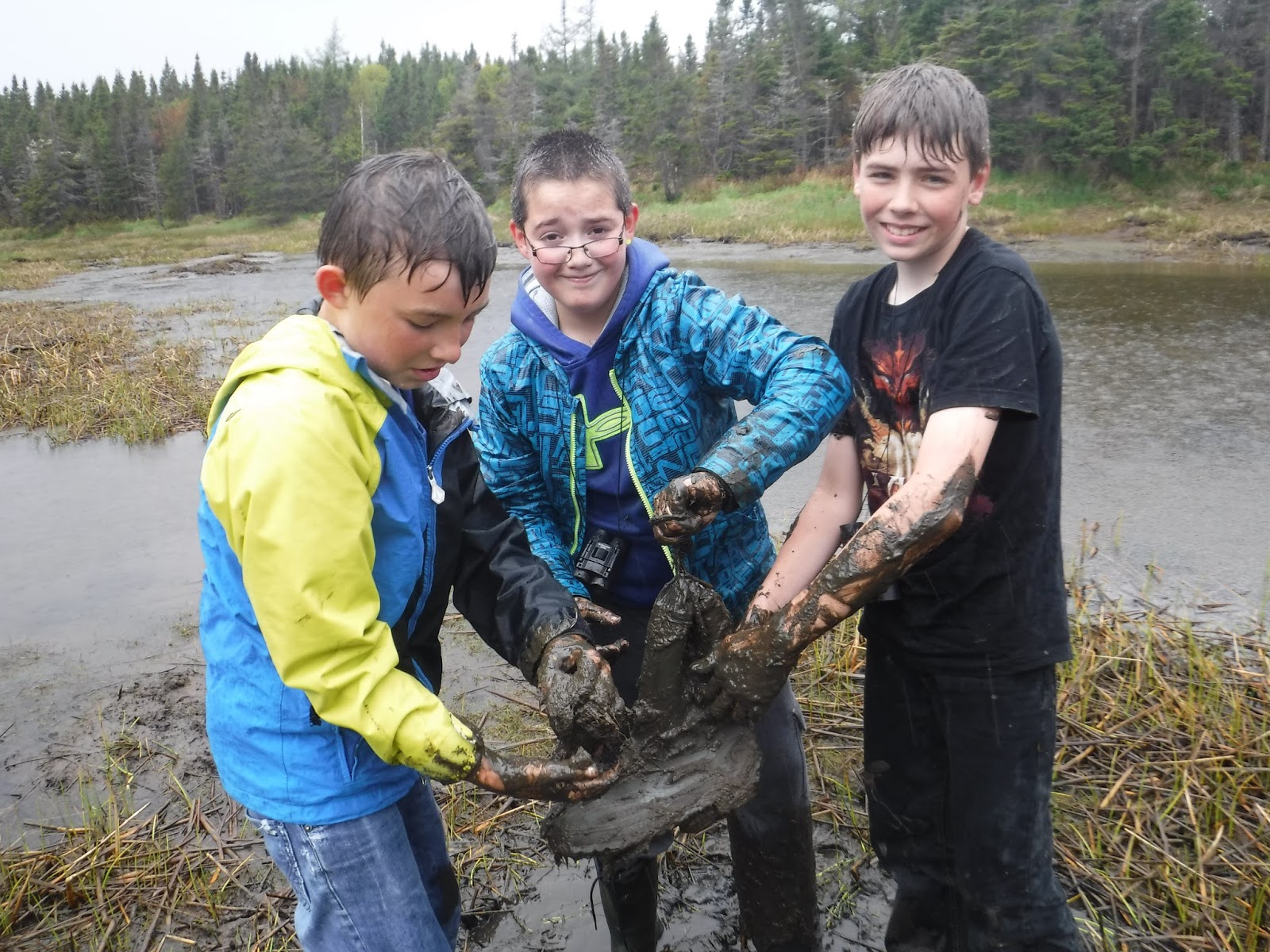
A little rain didn't deter these grade 4 students from having a
great field trip in Winterland!
Ducks Unlimited Canada is a valued partner of SAM. DUC works to conserve, restore and manage wetlands as well as the wildlife found within. An especially popular initiative of DUC is their Project Webfoot program. Project Webfoot creates the opportunity for grades 4-6 students across Canada to learn and connect with nature through curriculum-linked, interactive field trips in and around wetlands, as well as supplying in class and on-line resources for educators and students.


Grade 4 students from French Shore Academy learn about cavity
nesting tree ducks before going birdwatching at the Torrent River
Interpretation Centre in Hawke's Bay.
Delivery of these field trips for the 2015-2016 school year wrapped up in late June. Along with DUC NL staff, field trips are provided by three delivery partners: Corduroy Brook Enhancement Association in Grand Falls - Windsor, the Suncor Energy Fluvarium in St. John's and the Indian Bay Ecosystem Corporation on the Bonavista North peninsula. In September, Healthy Waters Labrador in Happy Valley - Goose Bay will become the fourth delivery partner in the province. This spring, DUC NL staff traveled to several SAM member municipalities to deliver Project Webfoot field trips: Winterland, Springdale, Hawke's Bay and Stephenville Crossing. 


Students dip for critters in Stephenville Crossing.
Some activities a class might expect on a Project Webfoot field trip include critter dipping in marshes and ponds for macro invertebrates, birdwatching around the area, and multiple fun games that focus on the values of our wetlands. This year, an effort was made to focus the material and the messaging on the boreal forest and peatlands of Newfoundland and Labrador. At the end of the field trip students go home with informative Marsh World books. Costs of in-class and field trip resources are supplied generously through corporate and individual sponsorships.


The Indian River Trail, Springdale.

Monday, 4 July 2016

Carmanville Habitat Committee Beach Clean-Up

Beach Clean-Up and Carmanville Habitat Committee volunteers.

On Saturday, June 4, 2016, the Carmanville Habitat Committee(CHC) sponsored its first beach cleanup, in recognition of World OceansDay.  This day is celebrated annually, on June 8th.  The idea is to create awareness of ocean pollution.  This year's theme was "Healthy Oceans, Healthy Planet" with the focus on reducing plastic pollution, which harms many aquatic species.  More than a dozen volunteers, including several committee members and the mayor, Keith Howell, met at the government wharf Saturday morning.

Volunteers spent three hours picking up garbage and debris along the north side of Carmanville Harbour.  In this short time period, over 60 bags of garbage were collected, along with numerous larger items such as chairs, artificial Christmas trees, TV's, etc. 

Some of the garbage removed from the beach,
The Carmanville Harbour Authority provided refreshments to the volunteers following the cleanup.  In addition, DFO supplied the CHC with work gloves, reusable shopping bags, back packs and pencils to distribute to the volunteers in appreciation for their efforts.

The CHC would like to thank all those who volunteered in any way to make this beach cleanup a success.  We look forward to sponsoring additional beach cleanups in the future. By keeping our beaches free of plastics and other debris, we can ensure a healthier ocean and a healthier planet.